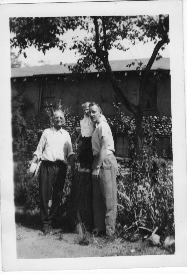
 Henry, Dad, and me in front of
5 So. Fox., circa 1950
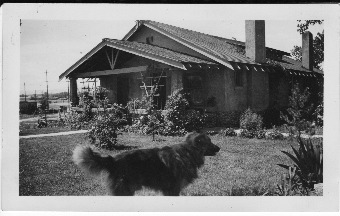
5 So. Fox, circa 1930 |
5
So. Fox
word count - 957
A Trip Down Memory Lane
by Dianne Roth
One day, on a whim, my 84 year old father suggested we drive by the house where he grew up.
The privacy hedge was so dense we could not see the front of the house. We parked and walked along the sidewalk, peeking through the bushes to catch glimpses of the river-cobble foundation he helped build. At the front gate there were a dozen signs, in a dozen languages, warning tresspassers to "Beware of the Dog". We wouldn’t be knocking at that door!
We spotted the plaque telling us that Henry and Mary's house had been listed on the National Register of Historic Places.
Not wanting to be torn to pieces by the dog, we continued along the walk and around the corner. Pulling bushes apart, I laughed, “We will probably be arrested!” In the alley, at the back gate, we saw someone. I hollered, “Hello, we’re at the back gate.” As a man’s face appeared, I said, “I have someone here you will want to meet.”
He asked, " Did he help build this house?"
Ushered through the front gate and introduced to a tiny muffin of a dog, Michael and his son invited us to sit on the old, familiar porch.
We chatted about family stories and changes in the neighborhood. Our contributions to the house’s lore must have convinced him that we were the genuine article. We were invited on the grand tour. Around the side of the house, into the backyard. Trees, a shed, a pond, the slope of the yard, a garage converted to an apartment, were all familiar to us.
As Dad hobbled along the walks, he recalled his childhood. It was amazing to both of us how little had changed. Then, we saw the swimming pool. It was where the driveway should have come down the slope from the street, turning into a garage under the house. We laughed as we thought of Henry and Mary’s surprise at a swimming pool in their yard.
The house was built in the early 1920’s, mostly of found materials. Henry and his sons drove to the river, at least a hundred times, and loaded the car with river rock. He and the older boys had to push the model-T out of the river with my four-year-old father steering. The sand for the concrete was mined on the property with Henry lowering the boys into the hole to fill buckets. The walls were built with specially fired insulated bricks which were interspersed with river rock and old broken bricks as rip-rap.
The kitchen remodel exposed a cutaway of one of Henry’s walls showing a concrete conglomerate that would never pass code today, but have stood the test of time. . Michael and Donna have the wall showing as part of the kitchen decor. Henry would scoff at letting the world see his building materials.
All around the house, including the swimming pool, Michael and Donna have added their own found-materials touch. The decking of the pool is red flagstone found..... In the yard is a three foot rooster made from old, rusted signs. The raised ceiling in the kitchen nook is the home for their collection of old radios, collected, Michael said, “before they got expensive”. On the wall of the dining room is a row of pastel glass lamp shades and along a shelf just below the ceiling is a collection of art deco vases. Mary would have loved it.
One of the most striking of the found materials on the property is the roofing and siding materials on the two apartments and various sheds. Apparently, Henry was down at the train yards and saw a pile of discarded lids from railroad spike kegs. When the spike kegs were opened, the lids were tossed in a heap. Henry asked if he could have them. They were probably glad to have them gone. The lids are tin, about 12 inches in diameter with a six inch raised section in the center. Overlapped, they make essentially indestructible roofing tiles and siding. Michael said he has repainted them once or twice in the 28 years he has owned the house. In fact, when one of the sheds deteriorated, he salvaged the lids, rebuilt the shed as an arbor, and used the lids to side and roof the new pump house for the swimming pool. Dad was delighted!
Most of the sheds were originally built to hold a cot for the transients who travelled the rails during the depression. For a few cents, they would have a place to sleep, out of the weather. There was a bathroom in the garage under the house they could use and Mary would hand sandwiches out the back door. In the 1940’s, the city mandated the sheds could not be used for sleeping.
When Michael and Donna upgraded the basement to a family area they upgraded the simple bathroom. Wanting to make one of the walls out of river rock to match the house, Michael and his son decided to gather the rock themselves, as Henry had. They drove to the river, gathered a load, and drove home. Humbled by how many times Henry had done this backbreaking work, they called the local quarry and had the rest of the rocks delivered. You wouldn’t know the wall was a new addition.
Dad told the story of how he had worked on his car in the garage. Michael laughingly said, “So, we have you to blame for the grease spot on the floor?” Sure enough, we were shown the grease spot on the family room floor. “I have painted it a dozen times, and it always reappears!”
For three hours, Michael and Donna shared their home and hospitality with my dad and me. Henry and Mary would have been so pleased.
Dianne Roth is a teacher, mother, grandmother, and freelance
writer. She lives in Oregon.
|
|