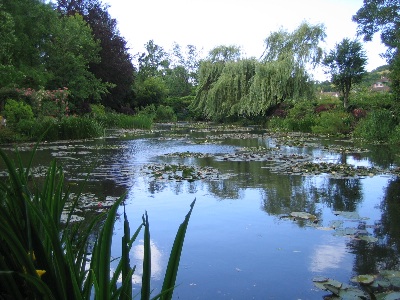
Monet’s Pond
during a break in the clouds
Giverny, France
(#1097)
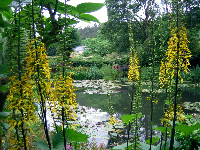
Monet’s Pond, Giverny, France
(#1085)
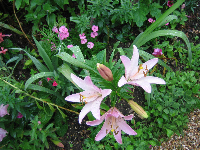
Day Lilies, Monet’s Garden
Giverny, France
(#1079)
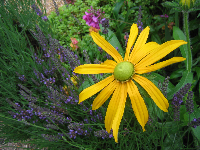
Rudbekia, Monet’s Garden,
Giverny, France
(#1075)
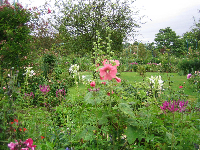
Borders, Monet’s Garden
Giverny, France
(#1072)
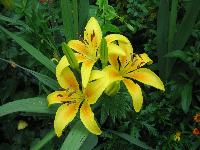
Day Lilies, Monet’s Garden
Giverny, France
(#1069)
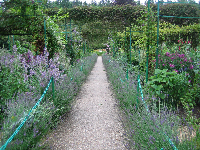
Winter Borders, Monet’s Garden
Giverny, France
(#1077)
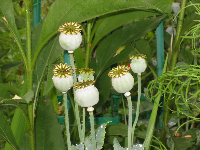
Poppy Pods, Monet’s Garden
Giverny, France
(#1070)
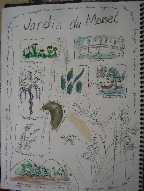
Sketchbook impression of
Monet’s Garden
(#1378)
|
Monet's Garden
1430 words
A Dream Day Jean Claude Monet's Garden
by Dianne Roth
Sometimes, dreams come true and sometimes dreams come altered. My dream visit to Jean Claude Monet’s famous garden in Giverny, France, was one of those altered dreams.
In 1999, I made my first trip to France on a sketching workshop in Provençe. I arrived in Paris and left on the next train. I vowed I would return and realize my dream.
This summer I made plans to do just that. From a friend I learned that the garden, though officially closed on Mondays, was open to artists who applied early. The Monet Foundation website said artist visits were difficult to arrange. With that negative outlook, I set out to finagle a Monday visit.
In April, two months before my arrival in Paris, I wrote to the foundation. I applied as a writer and sketch artist. I felt I was stretching the truth a bit, but I included a web address showing my work. They could decide if I qualified. My mail carrier learned to smile and say, “Nope, nothing from France,” and I flew to Paris not knowing if I had a spot.
Finally, with time fading away, I had to phone the foundation office. In painful French, I asked my question and found out that I had a reservation on Monday, July 4. Ecstatic, I turned from the phone booth and entertained the people sharing my street corner with a loud, “Woo-hoo!” They seemed to be thrilled with my good fortune.
Now, dreams are funny things. Sitting on the back burner for so long, they have the ability to stew themselves into a melting pot of mixed emotions. My first thought was fraud! I am not a real artist and now I only have 10 days to learn how to paint flowers like Monet!
My sketching mentor, Mari le Glatin Keis, finally took me to task. Her lecture was quick and effecient. “Sketching is the recording of the emotion of the moment. It is not the esthetic.” She pointed out that I may just walk around the garden and sketch nothing, “and that will be just fine.” She was concerned that my high expectations were going to end in disappointment. I listened, but when she was not looking, I practiced flowers.
July 4, dawned cold, grey, and rainy. I rolled over and covered my head. Ten minutes later, I checked again... still raining. I dragged myself out of bed and hauled myself to the metro in time to catch the train to Vernon, a few miles from Giverny. Under my umbrella, I caught a taxi. I was left, in the rain, at the door of Monet’s pink house, my beautiful, new umbrella still in the dry back seat of the taxi. My spirits began to fade.
It took an hour for a gardener to repond to my knocks and hellos, and I finally entered Monet’s Garden. Rain and frustration filled my mind, the flowers were sodden, and the promised restaurant across the street was closed on Mondays. Standing, waif-like, in the workshop, I got a grip on myself and replayed Mari’s words. “You may not sketch at all. Just enjoy your dream-come-true.” And, I began to walk.
Up and down the walkways I went. Looking at the petite and the panorama, near and far. My sketchbook stayed in my satchel for over an hour. I simply wandered, in awe of walking in the foot prints of Jean Claude Monet. And, my spirits began to raise. A rose here, a poppy seedcase there, the hour was slow and simply spent. I breathed in Monet with every breath.
From my amblings around the perimeter of the garden, trying to gain entry, I knew that the back garden wall was bounded by a road. When I reached that back wall, I was puzzled about where the water lily pond might be. I thought it must be quite small, and appeared large because of Monet’s artistic license. The puzzle was solved in the far back corner of the garden. An underground tunnel led under the road and into another huge, water garden.
Dreams play games with you if you do not watch out. About four days before my scheduled visit, I had a nightmare. I was in an ampitheater looking down into a postage-stamp-sized garden with a tiny pond on the side. The speaker was telling us that we had to stay in our seats and could not come close to the garden. I was horribly disappointed.
When I walked out of the tunnel and began to explore the water garden, I was anything but disappointed. Large and abundant, it washed away all frustration and disappointment, and I have the impression that the sun began to shine at that moment. I understood why Monet chose such large canvasses to record his watery domain.
The waterlilies were just as he had left them, placed just so to catch the light. The willows trailed seductively in the water. Blossoms, in every color, played hide and seek with butterflies and bird songs filled the air.
It was still cold and damp, my toes were chilled in my open toed travel sandals. But, I found a bench and opened my sketchbook. Waterlilies trailed across the page. I listened and let the whisper of Monet guide my hand as I experimented with shapes and colors. The blossoms, the barest of pink, were wide open to catch the few sun rays.
So engrossed I was, that I failed to notice the two huge slugs exploring my foot. I am sure Mari would have calmly sketched them before gently returning them to their own environs, but I yelped and flicked them into the bushes. A bit embarrassed, I sketched one from memory to capture the “emotion of the moment”.
To the waterlilies I added the purple lavetera and sidulsea, relatives of the hollyhock. There were black-eyed Susans, delphinium, larkspur, campanula, veronica, lady’s mantle, poppies, tiny erigeron daisies, and roses, to mention a few that I recognized from my own garden. There were hostas, ferns, and hydrangas with pinks, blues, and purples on the same bush. I even found a mahonia and a gaultheria, our very own Oregon grape and salal.
Moving from bench to bench, I sketched with pen or pencil, experimenting with my watercolor paints. My hand took on a life of its own, letting the brush flick across the paints to pick up all the necessary colors. Tiger lilies glowed with warm oranges, while the bark of an old maple was softened with purples. The willows flowed with blues and browns.
Warm afternoon sun sent the slugs and snails into hiding, but not before they were captured in my sketchbook.
Still feeling a bit like a fraud, I was joined on my bench by Pam Bowen, a self proclaimed Flower Painter. She was from Britain and had escorted a group of ladies from Britain and Wales on an annual visit to the Garden. She was interested in my sketchbook and was willing to share hers. With dibs and dabs of color, she had made the flowers in her book come alive. I was entranced by the simplicity of her work and she was inspired by my use of collage and washes. I asked her to sign my book to be part of my collection of memories and she returned the favor.
Back through the tunnel, I retraced my steps through the flower garden, this time with my sketchbook in hand. I wandered past gardeners dead heading tired blooms, transplanting tiny starts, and pruning shrubs and trees. In another corner I discovered the turkeys strutting their stuff. It could be 100 years ago.
While busy with my own thoughts and sketches, the garden had opened to a an art class. They were the serious artists with palettes and easels. I casually looked over their shoulders as I walked by, knowing that, unlike sketchers, talking with them would interrupt their concentration.
On any other day, the garden would be wall-to-wall tourists jockeying for the best digital photo and having to obey the marked traffic patterns. The birds, if still singing, would be drowned out by the human hordes. Today, the garden was Monet’s and mine. We walked the path together, pointing out flowers and visual vingettes, sharing possibilities for painting, noting the unusual light.
I was happy. Flowers ran across the pages along with my slug. It was not Monet, or anything close. It was the emotion of the moment that I had captured and I realized that the dream that came altered had turned into the dream come true.
Dianne Roth is a teacher, mother, grandmother, and freelance
writer. She lives in Oregon.
|
|