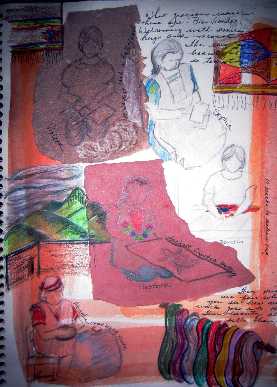
Impressions of the
Woman’s Weaving Collective,
Teotitlan de Valle, Mex.
(00017)
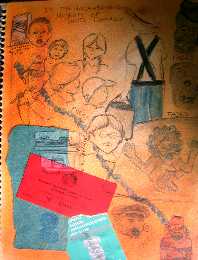
Impressions of faces in
Museo de Santo Domingo,
Oaxaca, Mexico
(#0184)
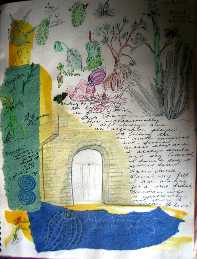
Impressions of
La Jardin de Botanica,
Oaxaca, Mexico
(#00015)
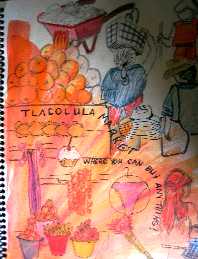
Impressions of
el Marcado de Tlacolula, Mexico (#00016)
|
The Art of Travel
1280 words
A Sketching Workshop In Oaxaca, Mexico
by Dianne Roth
“The Art of Traveling with a Sketchbook” is a travel workshop led by Corvallis artist Mari Le Glatin Keis. Her10-day workshops are designed around a tour that gives even the beginner the experience of recording travel impressions with whatever medium is at hand. She offers workshops in Mexico, Spain, France, and the Pacific Northwest. In November, I took my second trip with her to Oaxaca, Mexico.
A page of my sketchbook is full of collage, lines, colors, words, even the gritty soil of where I was sitting. And,.... the smell of chilies... a vendor on a bike shouting, “Agua!”.... cobblestones underfoot, a sky so blue as to be impossible, and the warm November air on skin.... I close my eyes and it is all there, the flavor, the aroma, the sound, the texture of Oaxaca, Mexico.
How can this be? I am sitting in my living room, sharing the stories from my sketchbook with a friend. And yet, I experience vivid sensory memories from months ago.
The trip to sunny Oaxaca came precisely at the beginning of Oregon’s rainy season. Participants of the workshop gathered at Casa Arnel, a classic Oaxaqueño hotel in the old part of the city. The outer door opens onto a luxurious jungle of tropical plants that keep the inner courtyard of the hotel, only a few steps from the heat of the street, cool and inviting. All of the rooms open into the luscious garden that holds a lending library and a concrete cistern for doing laundry. The accommodations are simple, clean, and picturesque.
In the morning we trickled out of rooms and found our way to the inviting rooftop terrace. The first workshop meeting was over a hearty Mexican breakfast buffet. Mari introduced us all and travel stories were shared. A few of the more adventurous had used their new art tools to illustrate their travels from home.
With few words, Mari shared the approach of the workshop and the agenda for the next 10 days. Over and over she encouraged us, “Keep your eyes wide open.” She reminded us to record more than just what we see. “This workshop is the art of travel. Sketch with your eyes and trust your hand to follow. There are no mistakes in sketching.”
Then, we headed out onto the streets of Oaxaca. Journals began to collect the the bougainvillea, the wash of the stucco, the patterns of pottery and rugs, and a collage of found objects. There were art galleries and bibliotecs, markets and coffee houses, small chapels and gilded altars. The participants clung to each other for a day or so before feeling comfortable enough to find our own way “home” or to dinner.
Some traveled the back alleys to find unique churches. Some spent hours pouring over and sketching artifacts in the many museums. Some sat in “el Llano” (the park) quickly using the new skill of gestural drawing to capture children visiting the Literacy Fair or playing ball. All used their colored pencils, watercolors, pastels, and glue sticks to record their sensory footsteps. “It is not the aesthetic,” reminded Mari as we ooo’d and aaa’d over the sketchbook pages. “It is the art of traveling in a different way. It is your very own emotion and experience that you record on the page.”
For five of the ten days we stayed in Oaxaca. Santo Domingo, the state museum and arboretum; the zocalo, the town square filled with music, dancing, food, and people; the indoor market to buy molé negro and chapulinas (fried grasshoppers); Museo Juarez with a collection of pictures taken by a blind photographer; M. Alcala’s for beautiful handmade paper; and shopping for clothing, silver, rugs, toys, and pottery. It was all on the pages of our sketchbooks.
On alternate days, Mari would lead the group to surrounding villages. We went to Monte Alban, ancient ruins of the Zapotec; Teotitlan, a weaver’s village; Tlacolula, the oldest continuous Sunday market in Oaxaca, where you can buy anything and even sample the local mescal; Ocotlan, the manufacturing center of black pottery; the Tulé Tree, considered the largest tree in the world; the ruins of Mitla where the voices of the village carry into stone rooms and transport you to a time before European history. And, on each new day of the 10-day workshop, Oaxaca began to come alive in our journals.
Each morning, over delicious breakfasts and luscious Mexican hot chocolate, Mari gave us simple demonstrations on how to do watercolor washes, gestural and contour drawings, and collage. “These are the basics.” Or, as Mari would often say, “You do not learn how to sketch, you sketch.” Sometimes she would chide, “Don’t draw all the bricks!”
Each evening, before dinner, we would gather on sidewalk benches or in one of the cool bibliotecs to share adventures and our efforts to capture them. Mari encouraged us to set aside our cameras as much as possible. “Trust your sketchbook to record the images. You will remember much more of your travels if you let your hand record what you can sense around you.” It was true. A small sketch of a chair reminds me of the warmth of the sun and the aroma of fresh tortillas. I can “see” the sky, the walls, the tiles, and the bougainvillea.
As the days went by, my sketchbook became an invitation to travelers from around the world. All 40 members of a family reunion from Mexico City squeezed into my shade at the top of a pyramid to examine my sketchbook. They laughed at my primitive Spanish and were charmed by my sketches. This intimacy with Oaxaqueños happened everywhere I sat to sketch. “Traveling with a sketchbook in hand sets you apart from the regular tourist.” I found many opportunities to step into local culture. My sketchbook was my ticket.
With sketchbooks full, we would head to dinners of delicious Oaxaqueña cuisine, molé negro, pesolé, tortilla soup, as well as gracious Oaxaqueña hospitality.
Mari had given each of us a list of supplies and encouraged us to experiment. “Travel light,” she would say, “Everything in a small backpack.” She reminded us to be humble as we traveled. “Humility allows you to see grandness in the simplest scene. If you make your record simple, you will remember the grand.”
Some came with art experience. Some came with none. We found that novices and experienced artists are all the same when it came to “seeing”, All of us left with our travels recorded in a keepsake. Bring your camera, but it is your sketchbook that will tell your story.
This was my second “The Art of Travel With a Sketchbook” workshop. I have traveled with Mari to the South of France and will be joining her in Oaxaca again in November.
As I look over my travels in my sketchbooks, I am struck by a new confidence I am beginning to feel. My second trip with a sketchbook is far more bold, sweeping, and free. There is emotion and a connection to people and places that I did not see in my French sketches. I am looking forward to seeing what will unfold in my third travel sketchbook.
Mari Le Glatin Keis, a French artist living in Corvallis, Oregon, provides participants with 10 days of living and sketching in Mexico, France and Spain. Her next workshop will be held in La Comera, one of the Canary Islands. To find out more about future Art of Travel Workshops or to contact Le Glatin Keis about openings in the 2005 workshops, see her web site at: http://artraveljournals.com/
Dianne Roth is a teacher, mother, grandmother, and freelance
writer. She lives in Oregon.
|
|